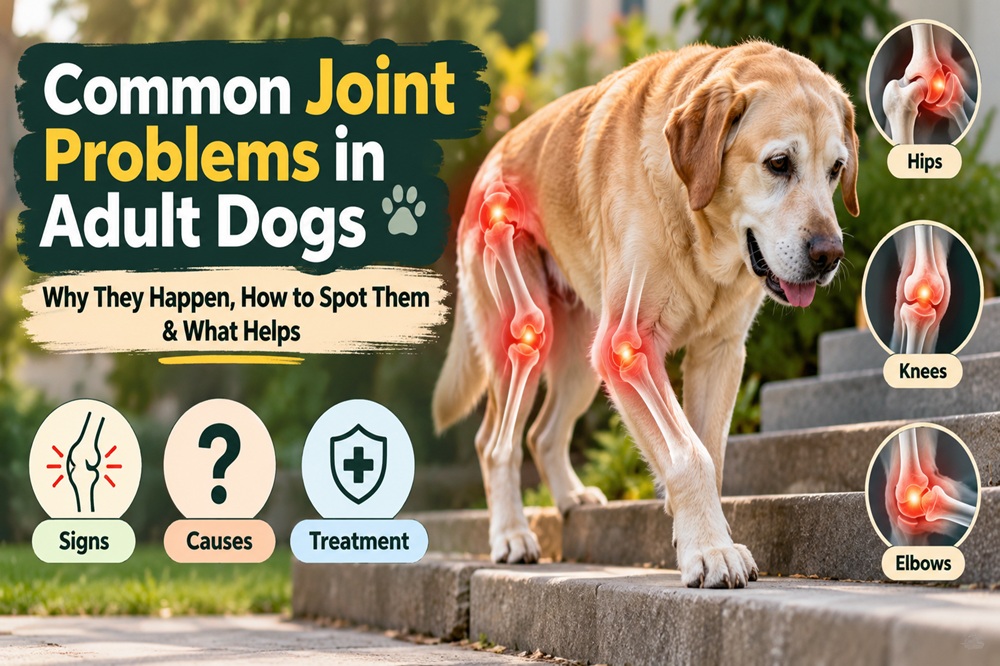
Watching your adult dog slow down can be worrying. Maybe they take longer to get up after sleeping, avoid the stairs, or no longer want to play as much as they used to. Sometimes these changes are simply noticed as “getting older,” but they can also be signs of a joint problem.
Joint issues can affect dogs of different ages and sizes. Some develop because of genetics or the way a joint is formed, while others are linked to injuries, excess weight, repeated strain, or gradual changes in the joints.
The important thing is to notice changes early and understand what your dog may be experiencing.
Why Do Adult Dogs Develop Joint Problems?
A dog’s joints work hard every day. Running, jumping, climbing stairs, playing, and even getting up from the floor all put pressure on the muscles and joints.
Joint problems can develop when the structures supporting a joint become damaged, unstable, inflamed, or gradually deteriorate.
Some common reasons include:
- Previous injuries
- Excess body weight
- Genetics
- Abnormal joint development
- Repeated high-impact activity
- Lack of appropriate exercise
- Age-related changes
- Problems affecting the hips, knees, elbows, or other joints
Not every dog with a joint problem will have the same cause. That’s why identifying the underlying problem is important before deciding how to manage it.
What Are the Most Common Joint Problems in Adult Dogs?
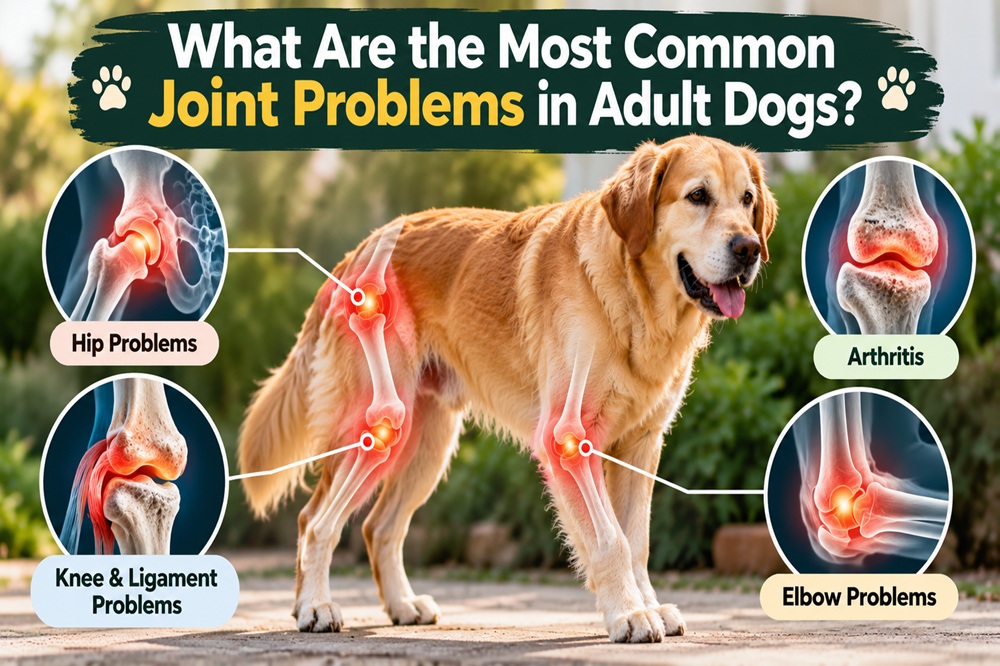
Several conditions can affect an adult dog’s mobility.
Arthritis
Arthritis can cause inflammation, discomfort, stiffness, and reduced movement. A dog with arthritis may not suddenly become unable to walk. Instead, you may notice small changes over time.
For example, your dog may:
- Take longer to stand up
- Walk slowly after resting
- Avoid jumping
- Play for shorter periods
- Seem stiff after exercise
- Prefer lying down instead of moving around
Hip Problems
Hip problems can make activities such as running, climbing stairs, or getting into a car difficult.
Some dogs may develop an unusual walking pattern or become reluctant to use their back legs normally.
Hip problems can have a genetic component, but body weight, activity and other factors can also affect how comfortable a dog is.
Knee and Ligament Problems
The knee is particularly vulnerable to injuries involving the ligaments that help stabilize the joint.
You may notice your dog suddenly putting less weight on one back leg or becoming reluctant to run.
A sudden limp shouldn’t automatically be assumed to be arthritis. An injury, ligament problem, paw injury, or another condition could be responsible.
Elbow Problems
Problems affecting the elbow can cause pain or stiffness in the front legs.
A dog may appear fine while walking slowly but become noticeably uncomfortable after running or playing.
How Can You Tell If Your Adult Dog Has Joint Problems?
Dogs don’t always make it obvious when something hurts.
Instead of crying or constantly limping, they may simply change their normal behavior.
Look for changes such as:
- Getting up more slowly
- Avoiding stairs
- Hesitating before jumping
- Walking slower than usual
- Sleeping more
- Playing less
- Stiffness after resting
- Limping occasionally
- Difficulty getting into the car
- Avoiding slippery floors
- Sitting or lying down differently
- Becoming less interested in walks
One change by itself doesn’t necessarily mean your dog has a joint disease.
However, a pattern of changes is worth paying attention to.
Why Is My Dog Moving Less Than Before?
Reduced activity is easy to overlook.
You might think your dog has simply become calmer with age. But if an active dog gradually stops doing things they previously enjoyed, discomfort could be one reason.
For example, your dog might still be willing to go for a walk but turn around sooner than before.
Or they may still play but stop after a few minutes.
These subtle changes can be more useful than waiting for obvious signs of pain.
A simple comparison can help
Think about what your dog could comfortably do six months ago:
- How far did they walk?
- Could they climb stairs easily?
- Did they jump onto the sofa?
- How quickly did they get up?
- How long did they play?
Comparing their current behavior with their normal routine can help you notice gradual changes.
Why Is My Adult Dog Limping?
Limping has many possible causes, and joint disease is only one of them.
Your dog could be limping because of:
- A joint problem
- A muscle injury
- A ligament injury
- A paw injury
- A damaged nail
- A fracture
- Hip problems
- Knee problems
- Another orthopedic condition
If the limp is persistent, severe, keeps returning, or appears suddenly after an injury, it’s best to have your dog examined by a veterinarian.
Avoid assuming that every limp is arthritis and treating it without knowing the cause.
How Does Weight Affect a Dog’s Joints?
Your dog’s weight can have a major effect on mobility.
When a dog carries excess body fat, everyday movement can become more demanding. Extra weight can make existing joint problems harder to manage and may also make exercise more difficult.
This creates a frustrating cycle:
Extra weight → less comfortable movement → less activity → easier weight gain
Keeping your adult dog at a healthy body condition can therefore be an important part of supporting their mobility.
If your dog is overweight, avoid putting them on a sudden or extreme diet. A veterinarian can help determine an appropriate target weight and feeding plan.
How Are Joint Problems Diagnosed?
You may be able to notice that something is wrong, but determining why it is happening is much harder.
A veterinarian may want to know:
- When the problem started
- Whether it is getting worse
- Whether one or multiple legs are affected
- Whether exercise makes it worse
- Whether your dog had a previous injury
- Whether your dog’s activity has changed
- Whether they have difficulty with stairs or jumping
The veterinarian may also observe your dog’s movement and examine the affected joints.
Depending on the situation, additional tests or imaging may be recommended.
The goal isn’t simply to confirm that your dog is uncomfortable. It’s to determine what is causing the problem and what type of treatment is appropriate.
How Are Joint Problems in Adult Dogs Treated?
There isn’t one universal treatment for joint problems.
The right approach depends on the dog’s condition, age, weight, activity level, and overall health.
Treatment may include one or more of the following.
1. Weight Management
If your dog is overweight, getting them toward a healthier body condition can reduce the physical demands of everyday movement.
This is especially important if weight is contributing to reduced activity.
2. Controlled Exercise
A dog with joint problems doesn’t necessarily need to stop exercising completely.
In many cases, appropriate movement is useful for maintaining muscle strength and mobility.
However, the type and amount of exercise should match the dog’s condition.
Long periods of intense running may not be appropriate for a dog recovering from an injury, while gentle controlled activity may be more suitable.
3. Pain Management
If your dog is experiencing pain, a veterinarian can recommend appropriate medication or other pain-management options.
Never give human painkillers to your dog unless your veterinarian specifically instructs you to do so.
Some medications that are safe for people can be dangerous for dogs.
4. Physical Rehabilitation
Some dogs benefit from structured rehabilitation.
Depending on the problem, this may involve controlled exercises designed to improve strength, movement, balance, or flexibility.
5. Surgery
Certain injuries or structural joint problems may require surgery.
Whether surgery is appropriate depends entirely on the underlying diagnosis.
How Can You Make Your Home Easier for a Dog With Joint Problems?
Small changes around the house can make movement more comfortable.
Consider:
Use non-slip surfaces
Smooth floors can be difficult for dogs with weak or painful joints. Rugs or other secure surfaces can provide better footing.
Reduce unnecessary jumping
If your dog struggles to get onto furniture or into a vehicle, consider safer ways to help them rather than encouraging repeated jumping.
Provide a comfortable sleeping area
A supportive and comfortable bed can make getting up and settling down easier.
Keep essential things accessible
If possible, keep your dog’s food, water, and sleeping area somewhere they don’t need to repeatedly climb stairs.
Keep nails appropriately trimmed
Long nails can affect how a dog places their feet and may make movement on some surfaces more difficult.
What Exercises Are Suitable for Dogs With Joint Problems?
Exercise needs to be individualized.
For some dogs, gentle walking may be appropriate. Others may benefit from specific rehabilitation exercises recommended by a professional.
Avoid suddenly increasing exercise because you want your dog to “get stronger.”
If your dog has pain or a diagnosed orthopedic problem, ask your veterinarian what type and amount of activity is appropriate.
A useful rule is:
Don’t judge an exercise only by how your dog looks during it. Also watch how they move afterward.
If your dog becomes significantly stiffer or more uncomfortable after an activity, that activity may be too demanding.
Can You Prevent Joint Problems in Adult Dogs?
Not every joint problem can be prevented.
Genetics, development, previous injuries, and other factors can be outside your control.
However, you can support your dog’s long-term mobility by:
- Maintaining a healthy weight
- Providing regular age-appropriate activity
- Avoiding unnecessary high-impact exercise
- Addressing injuries promptly
- Monitoring changes in movement
- Providing good footing around the home
- Keeping regular veterinary checkups
Early attention is particularly useful because small mobility changes are easier to address than a problem that has been ignored for months.
When Should You Take Your Dog to the Vet?
Make an appointment if you notice ongoing or recurring:
- Limping
- Stiffness
- Difficulty standing
- Difficulty climbing stairs
- Reduced interest in walks
- Reluctance to jump
- Changes in walking
- Reduced activity
- Signs of discomfort when moving
Get veterinary help promptly if:
- Your dog suddenly cannot put weight on a leg
- There has been significant trauma
- Your dog appears to be in severe pain
- Their mobility suddenly becomes much worse
- They cannot stand or walk normally
Don’t wait for a dog to cry or show obvious pain before taking mobility changes seriously.
What About Joint Supplements?
Joint supplements are often marketed for dogs with mobility problems, but that doesn’t mean every dog needs one or that every supplement will produce the same results.
Before giving your dog a joint supplement, discuss it with your veterinarian—especially if your dog already takes medication or has another health condition.
A supplement should not replace proper diagnosis, weight management, appropriate exercise, or veterinary treatment when those are needed.
Final Thoughts from Whopet

Joint problems can quietly affect an adult dog’s comfort and daily routine. Small changes like slower walks, difficulty getting up, or avoiding stairs shouldn’t always be dismissed as normal aging. By maintaining a healthy weight, providing appropriate exercise, and paying attention to changes in movement, you can support your dog’s long-term joint health.
At Whopet, we believe that understanding these early signs is one of the simplest ways to give your dog a more comfortable and active life.