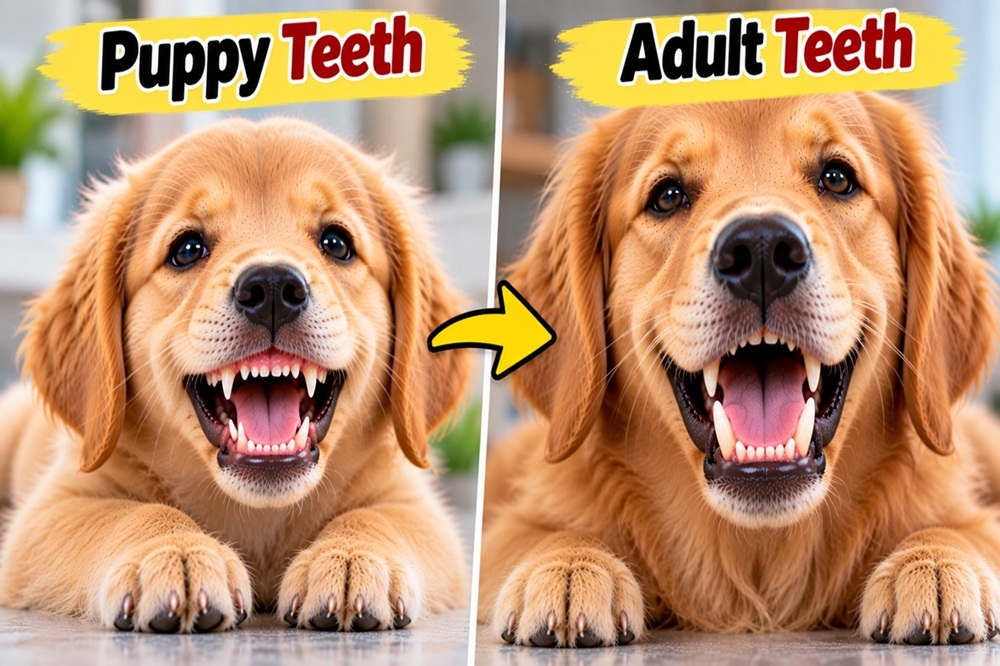
Puppies do not keep the same teeth throughout their lives. Like humans, dogs develop one set of temporary teeth and later replace them with a permanent set.
The small, sharp teeth you see in a young puppy are called baby teeth, milk teeth, or deciduous teeth. As the puppy grows, these teeth gradually loosen and fall out while larger permanent teeth emerge.
Understanding the difference between puppy teeth and adult teeth can help you recognize normal teething, spot dental problems early, and know what to expect during your puppy’s first several months.
How Many Teeth Do Puppies Have?
Most puppies develop 28 baby teeth.
These temporary teeth begin appearing when puppies are still very young. Baby teeth generally start erupting at around 3–5 weeks of age and are usually present by approximately 6 weeks.
Puppy teeth include:
- Incisors
- Canines
- Premolars
One interesting difference is that puppies do not have baby molars.
These baby teeth are smaller than adult teeth, but they are often surprisingly sharp. This is why puppy bites and chewing can feel much more painful than you might expect from such a small dog.
How Many Teeth Do Adult Dogs Have?
Most adult dogs have 42 permanent teeth.
The adult set includes:
- 12 incisors
- 4 canines
- 16 premolars
- 10 molars
Permanent teeth are larger and stronger than baby teeth and are designed to remain in the dog’s mouth throughout adulthood.
Most permanent teeth have erupted by approximately 6–7 months of age, although the exact timing can vary between individual dogs.
Puppy Teeth vs Adult Teeth: Main Differences
The easiest way to understand the difference is to compare their size, number, shape, and function.
| Feature | Puppy Teeth | Adult Teeth |
| Number | 28 | 42 |
| Also called | Baby, milk, deciduous teeth | Permanent or adult teeth |
| Appearance | Small and very sharp | Larger and generally more substantial |
| Development | Erupt during early puppyhood | Replace baby teeth during growth |
| Molars | None | Present |
| Purpose | Temporary teeth used while growing | Permanent teeth used throughout adulthood |
The most important difference is that baby teeth are temporary, while adult teeth are permanent.
When Do Puppies Get Their Baby Teeth?
Puppies are born without visible teeth.
Their baby teeth begin to emerge during the first few weeks of life. By roughly 6 weeks, most puppies have their full set of 28 deciduous teeth.
At this stage, puppies may already be using their mouths to explore their environment.
You may notice them:
- Chewing toys
- Biting during play
- Mouthing people’s hands
- Exploring objects with their mouths
- Chewing food and treats
This is normal puppy behavior, although it is important to teach puppies what they are allowed to chew.
When Do Puppy Teeth Start Falling Out?
The transition from baby teeth to adult teeth usually begins at around 3–4 months of age.
As permanent teeth develop underneath the baby teeth, the roots of the baby teeth gradually resorb. The baby tooth becomes loose and eventually falls out, allowing the permanent tooth to take its place.
The process usually happens over several months.
You may find a tiny tooth on the floor, in your puppy’s bedding, or inside a toy. However, many puppies swallow their loose baby teeth while eating, which is generally harmless.
Why Are Puppy Teeth So Sharp?
If you have ever been nipped by a puppy, you probably already know the answer.
Baby teeth are relatively small and pointed. Their sharp edges help puppies grasp food and interact with objects.
During play, however, those needle-like teeth can easily scratch human skin.
This is one reason early bite-inhibition training is important. Instead of encouraging puppies to bite hands, redirect their chewing behavior toward appropriate puppy-safe toys.
What Happens During Teething?
Teething is the period when permanent teeth replace the puppy’s baby teeth.
As the adult teeth develop, they gradually cause the roots of the corresponding baby teeth to disappear. Eventually, the baby teeth loosen and fall out.
During this period, your puppy may:
- Chew more frequently
- Want to bite toys
- Have mildly sensitive gums
- Drool more than usual
- Show mild mouth discomfort
- Have a small amount of blood on a chew toy
- Lose interest temporarily in very hard foods or objects
A small amount of blood can sometimes occur when baby teeth are being replaced. However, heavy or persistent bleeding is not considered normal and should be evaluated by a veterinarian.
Why Does My Puppy Want to Chew Everything?
Chewing is particularly noticeable during teething.
The developing teeth and changing gums can make a puppy’s mouth feel uncomfortable. Chewing may provide relief while also satisfying a natural exploratory behavior.
Unfortunately, puppies do not automatically understand which objects are safe to chew.
Shoes, furniture, wires, children’s toys, and other household objects can become tempting targets.
Providing appropriate chew toys and supervising your puppy can help redirect this behavior.
Avoid extremely hard objects that may damage developing or permanent teeth. Veterinary guidance specifically warns against items such as bones, antlers, very hard chews, and ice because they can cause tooth damage.
How Do Adult Teeth Differ From Puppy Teeth?
Adult teeth are not simply larger versions of baby teeth.
Adult dogs have additional teeth, particularly molars, which puppies do not have in their deciduous set.
Adult teeth are also designed for the dog’s mature diet and normal chewing behavior. The four main types—incisors, canines, premolars, and molars—have different roles.
Incisors
These are the small teeth at the front of the mouth.
They can help with:
- Grabbing small pieces of food
- Picking up objects
- Grooming
Canines
The four canine teeth are the prominent pointed teeth near the front of the mouth.
They help dogs grasp and hold objects.
Premolars
Premolars sit behind the canine teeth.
They contribute to gripping and cutting food.
Molars
Molars are located farther back in the mouth and are part of the adult dentition.
They help process food through chewing.
Can You Tell a Puppy Tooth From an Adult Tooth?
Sometimes it is easy.
Baby teeth tend to be:
- Smaller
- Very sharp
- Narrower
- More delicate-looking
Adult teeth are generally:
- Larger
- More substantial
- Broader
- More firmly established
However, identifying a tooth based only on appearance can sometimes be difficult, especially while your puppy is actively teething.
That is why regular mouth checks are useful.
What If a Baby Tooth Does Not Fall Out?
This is an important dental issue to watch for.
Sometimes a puppy’s baby tooth remains in place even though the corresponding permanent tooth has started to erupt.
This is called a retained deciduous tooth.
You may notice what looks like two teeth occupying the same area.
Retained baby teeth can cause crowding and may push the permanent tooth into an abnormal position. Food and debris can also become trapped between the teeth, increasing the risk of gum inflammation and other dental problems.
If you see a baby tooth sitting next to its adult replacement, contact your veterinarian rather than trying to remove it yourself.
Do Puppies Lose Every Baby Tooth?
Normally, the baby teeth should be replaced during the teething process.
By around 6–7 months, most puppies have their permanent teeth.
You may not see every baby tooth fall out because puppies frequently swallow them without any problem.
However, if you can clearly see a baby tooth remaining next to an adult tooth, it should be checked by a veterinarian.
When Should You Be Concerned About Your Puppy’s Teeth?
Teething itself is normal, but some dental changes need professional attention.
Contact your veterinarian if you notice:
- A baby tooth remaining beside an adult tooth
- Severe gum swelling
- Persistent bleeding
- A broken tooth
- Significant mouth pain
- Difficulty eating
- Facial swelling
- A tooth growing into an unusual position
- An abnormal bite
- Persistent bad breath
- Your puppy becoming reluctant to chew
Early examination can help identify developmental dental problems before they become more complicated.
How Can You Care for Puppy Teeth?
Dental care should begin while your dog is still young.
Start Tooth Brushing Gradually
Introduce your puppy to having its mouth and teeth handled slowly.
Use a toothbrush and toothpaste specifically designed for dogs. Never use human toothpaste unless a veterinarian specifically recommends a product that is safe for dogs.
Provide Appropriate Chew Toys
Choose toys designed for puppies and select an appropriate size.
The toy should be strong enough for chewing but not so hard that it can damage the teeth.
Check the Mouth Regularly
A quick visual check can help you notice:
- Loose baby teeth
- Emerging adult teeth
- Retained baby teeth
- Red or swollen gums
- Broken teeth
- Unusual tooth positioning
You don’t need to force your puppy’s mouth open. A gentle check is enough to spot many obvious changes.
Schedule Routine Veterinary Visits
Puppy checkups provide an opportunity for your veterinarian to monitor dental development.
This is especially useful during the months when baby teeth are being replaced by permanent teeth.
Puppy Teeth vs Adult Teeth: The Key Takeaway
Puppies normally have 28 temporary baby teeth, while adult dogs generally have 42 permanent teeth. Baby teeth start appearing during the first few weeks of life, and permanent teeth begin replacing them at around 3–4 months. By approximately 6–7 months, most puppies have their adult dentition.
The transition is a normal part of growing up, but it is also an important period for dental development.
Keep an eye on your puppy’s mouth, provide safe chewing options, and introduce dental care early.
Most importantly, if a baby tooth remains when its adult replacement has appeared, don’t simply ignore it. A veterinarian can determine whether treatment is needed and help protect the puppy’s developing adult teeth.
Healthy dental habits during puppyhood can make caring for your dog’s teeth much easier throughout adulthood.