Joint health is an important part of keeping an adult dog active, comfortable, and mobile. Adult dogs can develop joint problems because of previous injuries, excess weight, genetics, repetitive high-impact activity, or conditions such as osteoarthritis.

Joint supplements are often marketed as an easy way to support mobility and healthy joints. However, not every supplement works equally well, and some ingredients have stronger evidence than others.
If you are considering a joint supplement for your adult dog, understanding the ingredients, benefits, limitations, and safety considerations can help you make a better decision with your veterinarian.
What Are Joint Supplements for Adult Dogs?
Joint supplements, sometimes called nutraceuticals, are products designed to provide nutrients or compounds that may support joint function, cartilage, or inflammation.
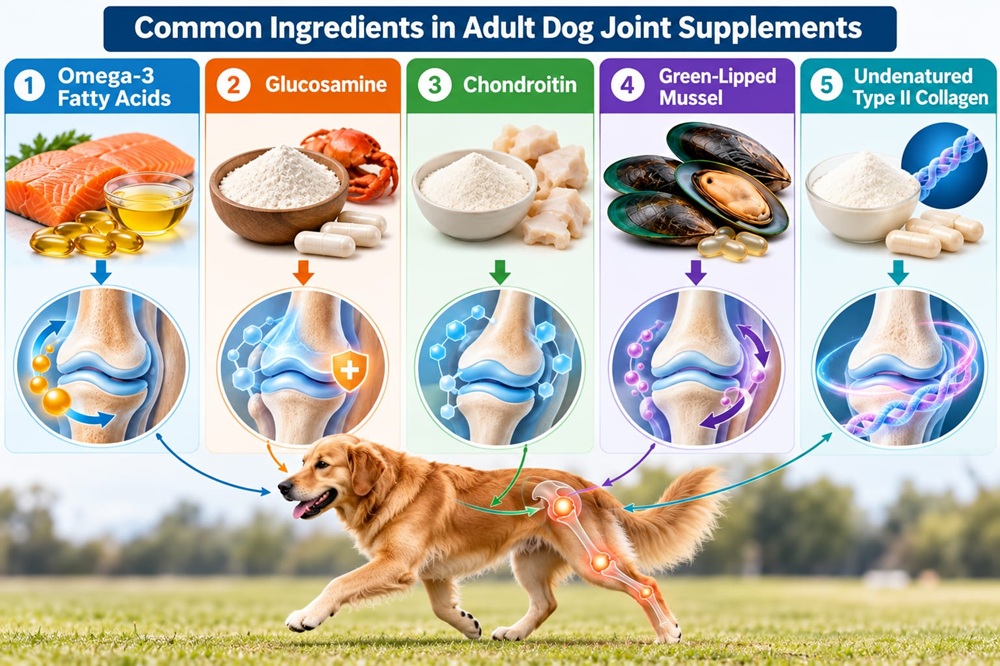
They may contain ingredients such as:
- Omega-3 fatty acids, especially EPA and DHA
- Glucosamine
- Chondroitin
- Green-lipped mussel
- Undenatured type II collagen
- Other vitamins, minerals, or herbal ingredients
The important point is that supplements are not the same as prescription medications, and they should not automatically be expected to eliminate joint pain. Research on different ingredients varies considerably.
Why Might an Adult Dog Need a Joint Supplement?
Adult dogs can experience joint stress even when they are not considered senior dogs.
Some adult dogs may be more likely to develop joint problems because of:
- Previous ligament or joint injuries
- Hip or elbow abnormalities
- Excess body weight
- High-impact exercise
- Repetitive jumping or running
- Breed-related joint risks
- Existing osteoarthritis
- Physically demanding working or sporting activities
For a dog already showing stiffness, limping, reluctance to climb stairs, or difficulty getting up, a supplement may sometimes be considered as part of a broader management plan. However, these signs should first be evaluated by a veterinarian because joint pain can have many causes.
Common Ingredients in Adult Dog Joint Supplements
Omega-3 Fatty Acids
Omega-3 fatty acids, particularly EPA and DHA, are among the more promising nutritional options for dogs with joint problems.
They can help support the body’s inflammatory response and may be useful for dogs with osteoarthritis. However, the amount of EPA and DHA matters, and simply choosing a product labeled “fish oil” does not guarantee that it contains an effective amount.
If your adult dog already eats a diet containing omega-3 fatty acids, additional supplementation may not always be necessary.
Glucosamine
Glucosamine is one of the most commonly found ingredients in canine joint supplements.
It is associated with cartilage and joint support and is frequently combined with chondroitin. However, research on how much clinical benefit glucosamine provides in dogs is mixed. Some veterinary sources consider it reasonable to try in selected dogs, while other evidence suggests the benefit may be limited.
For this reason, owners should avoid assuming that a glucosamine product will automatically relieve joint pain.
Chondroitin
Chondroitin is another popular ingredient commonly combined with glucosamine.
It is intended to support cartilage and joint function. However, as with glucosamine, the evidence for meaningful improvement in dogs is not as strong or consistent as marketing claims may suggest.
Green-Lipped Mussel
Green-lipped mussel is a natural source of several nutrients, including omega-3 fatty acids and other compounds that may support joint health.
Some veterinary sources report promising evidence for reducing orthopedic pain and supporting dogs with degenerative joint disease.
Undenatured Type II Collagen
Undenatured type II collagen is another ingredient used in some canine joint products.
It is intended to influence inflammatory processes associated with joint disease. Some veterinary sources consider it a potential option, but it should still be selected based on your dog’s individual needs rather than simply because it appears on a supplement label.
Are Joint Supplements a Replacement for Pain Medication?
No.
If an adult dog has significant arthritis or another painful joint condition, a supplement should not be considered a substitute for appropriate veterinary treatment.
Depending on the condition, a veterinarian may recommend a combination of:
- Weight management
- Controlled, low-impact exercise
- Physical rehabilitation
- Appropriate nutrition
- Pain-management medication
- Joint supplements
- Other veterinary therapies
A multimodal approach is often more useful than relying on a single supplement.
How to Choose a Joint Supplement for an Adult Dog
There are many joint supplements available as chews, tablets, capsules, powders, and liquids. Choosing one should involve more than simply picking the product with the longest ingredient list.
Check the Active Ingredients
Look for clearly stated amounts of important ingredients rather than vague claims such as “joint support formula.”
For omega-3 products, check specifically for EPA and DHA rather than looking only at the total amount of fish oil.
Consider Product Quality
Supplements are not regulated in exactly the same way as prescription medications, and product quality can vary.
Your veterinarian can help you identify reputable products and manufacturers.
Avoid Giving Multiple Products Without Checking Ingredients
Some adult dogs may receive a joint supplement, fish oil, a therapeutic diet, and other supplements at the same time.
Combining products without checking their ingredients can result in unnecessary duplication.
Consider Your Dog’s Existing Diet
Your dog’s regular food may already contain nutrients intended to support joint health. Adding another supplement may not always provide additional benefit.
A veterinarian can help determine whether your adult dog’s current diet already provides relevant nutrients.
Are Joint Supplements Safe?
Many commonly used joint supplements are generally well tolerated, but “natural” does not automatically mean “risk-free.”
Some products can cause digestive upset or other unwanted effects, and certain supplements may not be appropriate for dogs with specific health conditions or those taking certain medications.
This is particularly important if your adult dog is already receiving prescription medication.
Always discuss a new supplement with your veterinarian before starting it.
How Long Do Joint Supplements Take to Work?
Joint supplements are not usually expected to provide immediate pain relief.
The response can vary depending on:
- The underlying joint condition
- The ingredient
- Product quality
- Dosage
- Your dog’s overall health
- Weight and activity level
Rather than judging a supplement after only a few days, discuss an appropriate trial period and monitoring plan with your veterinarian.
Keeping track of your dog’s walking ability, stiffness, activity, and willingness to climb stairs or play can help you notice meaningful changes.
Weight Management Is Still Essential
A supplement cannot compensate for excess body weight.
Extra weight places additional stress on the joints and can make mobility problems more difficult to manage. Maintaining an appropriate body condition is therefore an important part of adult dog joint care.
If your adult dog is overweight, your veterinarian can help create a safe weight-management plan involving appropriate food portions, treats, and low-impact activity.
Exercise and Supplements Can Work Together
Joint supplements work best when they are considered as part of an overall joint-health strategy.
For many adult dogs with joint problems, controlled exercise can help maintain muscle strength and mobility. Activities may include:
- Gentle leash walking
- Controlled swimming
- Veterinary rehabilitation exercises
- Range-of-motion exercises when recommended
- Low-impact strengthening activities
The appropriate exercise level depends on your dog’s condition, so ask your veterinarian or rehabilitation professional for individualized guidance.
When Should You Contact a Veterinarian?
Do not rely on a joint supplement alone if your adult dog develops:
- Persistent limping
- Sudden difficulty walking
- Severe stiffness
- Swollen joints
- Reluctance to stand
- Difficulty climbing stairs
- Sudden unwillingness to run or play
- Pain when touched
- Signs of pain after an injury
A veterinarian can determine whether the problem is related to arthritis, an injury, ligament damage, hip or elbow disease, or another condition.
Final Thoughts
Joint supplements can be useful for some adult dogs, but they are not a universal solution for joint pain.
Ingredients such as EPA/DHA omega-3 fatty acids and green-lipped mussel have promising evidence, while the evidence for popular ingredients such as glucosamine and chondroitin is more mixed.
The best approach is to look at the whole picture: your adult dog’s weight, diet, activity level, joint condition, medications, and overall health.
Before starting any new supplement, talk with your veterinarian. A properly selected supplement, combined with healthy weight management, appropriate exercise, nutrition, and veterinary care, can be a more sensible approach to supporting your adult dog’s joint health.