For adult dogs with joint problems, regular movement can be challenging. Pain, stiffness, previous injuries, arthritis, or excess weight may make activities such as running, jumping, and long walks uncomfortable.
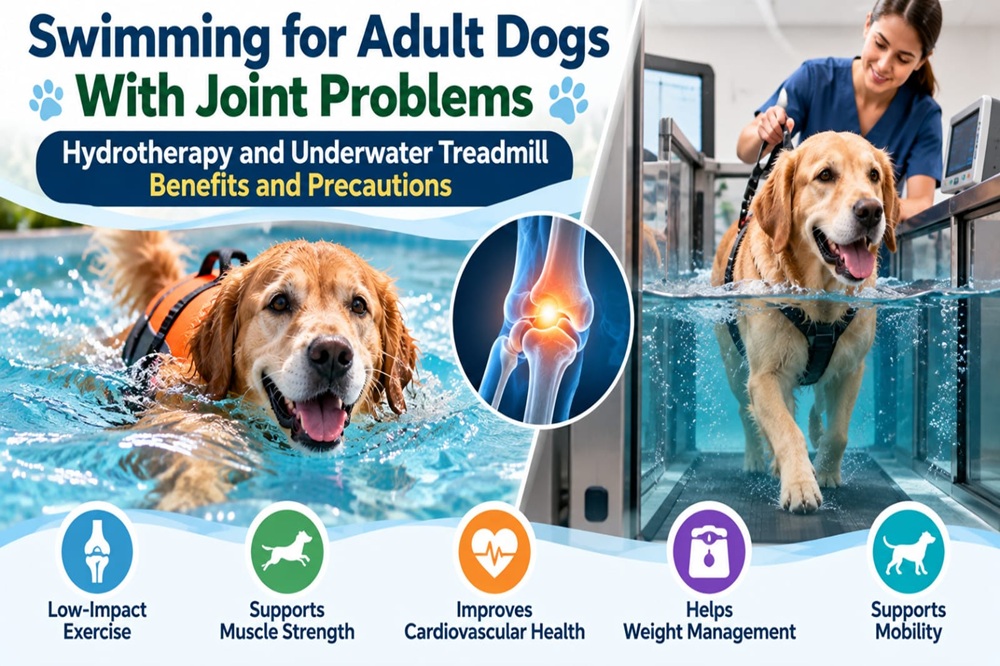
Hydrotherapy—which includes swimming and walking on an underwater treadmill—can provide a way for some adult dogs to exercise while placing less stress on their joints. Water provides buoyancy, which reduces the amount of weight the joints have to support, while water resistance can help strengthen muscles.
However, hydrotherapy is not appropriate for every dog and should not automatically be considered a substitute for veterinary treatment. The right type and intensity of water exercise should depend on the dog’s condition and rehabilitation goals.
What Is Hydrotherapy for Adult Dogs?
Hydrotherapy is a form of rehabilitation that uses water-based exercise to support mobility, strength, fitness, and recovery.
For adult dogs with joint problems, the two most common forms are:
- Swimming
- Underwater treadmill walking
Both use the properties of water to make exercise different from exercising on land.
Water provides:
- Buoyancy — reduces the amount of weight placed on joints
- Resistance — makes muscles work while the dog moves
- Hydrostatic pressure — may help with swelling and discomfort
- Warmth, when warm therapeutic water is used — can make movement more comfortable for some dogs
Benefits of Swimming for Adult Dogs With Joint Problems
1. Low-Impact Exercise
Swimming allows an adult dog to exercise without repeatedly putting its full body weight through the legs.
This can be useful for dogs whose joints become uncomfortable during higher-impact activities such as running or jumping.
2. Supports Muscle Strength
Joint problems can lead to reduced activity, which may contribute to muscle weakness.
Swimming provides resistance as the dog moves through the water, allowing the muscles to work while reducing some of the impact associated with land-based exercise.
Maintaining muscle strength is important because stronger muscles can help support normal movement and mobility.
3. Provides Cardiovascular Exercise
Swimming can provide a good cardiovascular workout for an adult dog.
It may be particularly useful when joint discomfort limits the amount of running or walking the dog can comfortably perform.
4. Can Support Weight Management
Maintaining a healthy body weight is an important part of joint care.
For an overweight adult dog, water-based exercise can provide an additional way to increase activity while reducing the load placed on painful joints. Veterinary rehabilitation programs may combine aquatic exercise with a structured weight-management plan.
5. May Help Maintain Mobility
Regular, appropriately prescribed exercise can help an adult dog maintain strength, flexibility, and functional movement.
Hydrotherapy can be one component of a broader rehabilitation program designed around the dog’s specific condition.
Swimming vs. Underwater Treadmill
Although both are forms of hydrotherapy, they are not exactly the same.
Swimming
Swimming provides a whole-body workout and can be excellent for cardiovascular conditioning and general muscle activity.
However, it can be difficult to precisely control how a dog moves while swimming. For this reason, swimming may not be ideal for every rehabilitation goal.
Underwater Treadmill
An underwater treadmill allows the dog to walk rather than swim while partially supported by water.
The rehabilitation professional can adjust factors such as:
- Water depth
- Walking speed
- Exercise duration
- Level of support
This allows the exercise to be customized more precisely to the adult dog’s condition and rehabilitation goals.
For some dogs, this controlled walking pattern may make an underwater treadmill more useful than swimming during rehabilitation.
Benefits of an Underwater Treadmill
Controlled Movement
Unlike free swimming, an underwater treadmill encourages a predictable walking pattern.
This can allow a rehabilitation professional to observe how the dog is using its legs and adjust the exercise accordingly.
Reduced Joint Loading
The buoyancy of the water decreases the amount of body weight the dog’s joints need to support.
This can make walking easier for some dogs with painful or weakened joints.
Muscle Strengthening
Water resistance makes walking more challenging for the muscles while the water reduces impact.
This combination can help build strength and endurance as part of a structured rehabilitation program.
Adjustable Rehabilitation
Water depth and treadmill speed can be modified to change the difficulty of the exercise.
This is one reason underwater treadmills can be particularly useful when rehabilitation needs to progress gradually.
Swimming and Underwater Treadmill Precautions
Hydrotherapy can be helpful, but more exercise is not always better.
1. Get Veterinary Guidance First
If your adult dog has arthritis, an injury, persistent lameness, weakness, or another medical condition, speak with your veterinarian before beginning hydrotherapy.
A veterinary rehabilitation professional can determine whether water exercise is appropriate and which type is safest.
Rehabilitation performed without proper assessment can potentially cause harm.
2. Don’t Force a Dog That Is Afraid of Water
Some dogs simply do not enjoy swimming.
Forcing a nervous dog into the water can increase stress and may create a safety risk for both the dog and the handler. If swimming is recommended but your adult dog is uncomfortable in water, professional guidance can help introduce the activity safely.
3. Use Appropriate Safety Equipment
A properly fitted flotation or buoyancy jacket may be appropriate during swimming, particularly when a dog is inexperienced, weak, or becomes tired easily.
Dogs should always be closely supervised around water.
4. Don’t Assume Swimming Is Appropriate for Every Injury
Different injuries require different rehabilitation strategies.
For example, swimming may not be appropriate during certain stages of specific muscle or orthopedic injuries. A rehabilitation professional should decide when and how water exercise should be introduced.
5. Start Slowly
An adult dog with joint problems may have reduced fitness or muscle strength.
Starting with too much exercise can lead to fatigue or soreness. A rehabilitation professional can establish an appropriate duration and gradually increase activity as the dog improves.
6. Watch for Signs of Discomfort
Stop the session and contact your veterinary team if your dog shows signs such as:
- Increased limping
- Sudden reluctance to move
- Excessive fatigue
- Difficulty getting up afterward
- Whining or obvious discomfort
- Unusual weakness
- Increased stiffness after exercise
Your dog’s rehabilitation plan may need to be adjusted if exercise causes soreness or worsening symptoms.
Is Hydrotherapy Better Than Regular Walking?
Not necessarily.
Hydrotherapy and land-based exercise serve different purposes.
For many adult dogs with joint problems, a rehabilitation plan may combine controlled walking, water-based exercise, strengthening exercises, weight management, and other veterinary treatments.
Hydrotherapy should generally be viewed as one tool within a complete joint-care and rehabilitation plan, rather than a standalone cure.
How Often Should an Adult Dog Have Hydrotherapy?
There is no single schedule that works for every adult dog.
The appropriate frequency depends on factors such as:
- The dog’s diagnosis
- Joint condition
- Muscle strength
- Fitness level
- Body weight
- Previous injuries or surgery
- Response to exercise
- Rehabilitation goals
A veterinary rehabilitation professional can create a personalized schedule and adjust it as the dog progresses.
When Should You Avoid DIY Hydrotherapy?
Home swimming may be reasonable for a healthy adult dog that already swims confidently, provided the environment is safe and the dog is supervised.
However, dogs with joint disease, significant weakness, recent surgery, neurological problems, or orthopedic injuries should not begin therapeutic swimming or treadmill work without veterinary guidance. Professional facilities can control water depth, speed, exercise intensity, and the dog’s movement more precisely.
Final Thoughts
Swimming and underwater treadmill therapy can be valuable options for some adult dogs with joint problems.
Swimming can provide low-impact cardiovascular and whole-body exercise, while an underwater treadmill offers more controlled walking and allows the rehabilitation team to adjust water depth and speed.
The biggest benefit of hydrotherapy is that water can reduce joint loading while still providing resistance for muscle activity. However, it should be introduced carefully and selected according to the individual dog’s condition.
For an adult dog with joint problems, the safest approach is to discuss hydrotherapy with a veterinarian or qualified veterinary rehabilitation professional before starting. When appropriately prescribed, water-based exercise can be a useful part of a broader plan to support mobility, strength, fitness, and quality of life.