Puppies go through a rapid period of dental development during their first few months of life. Their small baby teeth eventually fall out and are replaced by permanent adult teeth. This process usually happens naturally, but sometimes a baby tooth stays in the mouth even after its permanent replacement has started to erupt.

This condition is called a retained baby tooth, or retained deciduous tooth.
You may notice what looks like two teeth growing in the same area. While it may seem harmless, a retained baby tooth can interfere with the position of the permanent tooth and may contribute to crowding, food trapping, gum inflammation, and other dental problems.
What Are Retained Baby Teeth in Puppies?

Puppies are born without visible teeth. Their 28 baby teeth normally begin appearing at around 3–5 weeks of age. Later, permanent teeth begin to develop and replace those baby teeth. Most puppies have their complete set of permanent teeth by about 7 months of age.
Normally, the developing permanent tooth puts pressure on the root of the baby tooth. The baby tooth’s root is gradually resorbed, allowing the baby tooth to loosen and fall out.
A retained baby tooth occurs when this normal process does not happen properly and the baby tooth remains in the mouth while the permanent tooth is erupting.
In simple terms:
Baby tooth → should fall out → permanent tooth takes its place
With a retained tooth:
Baby tooth stays → permanent tooth also emerges → two teeth occupy the same area
Veterinarians may also call these teeth persistent deciduous teeth.
When Do Puppy Baby Teeth Normally Fall Out?
Teething usually begins when puppies are around 3–4 months old. During this period, permanent teeth gradually replace the baby teeth.
Most puppies have their adult teeth by approximately 6–7 months of age.
The exact timing can vary between individual puppies and breeds. Therefore, seeing a loose baby tooth during teething is not necessarily a problem.
The concern is when a baby tooth remains firmly in place while the corresponding permanent tooth has already started coming through.
What Do Retained Baby Teeth Look Like?
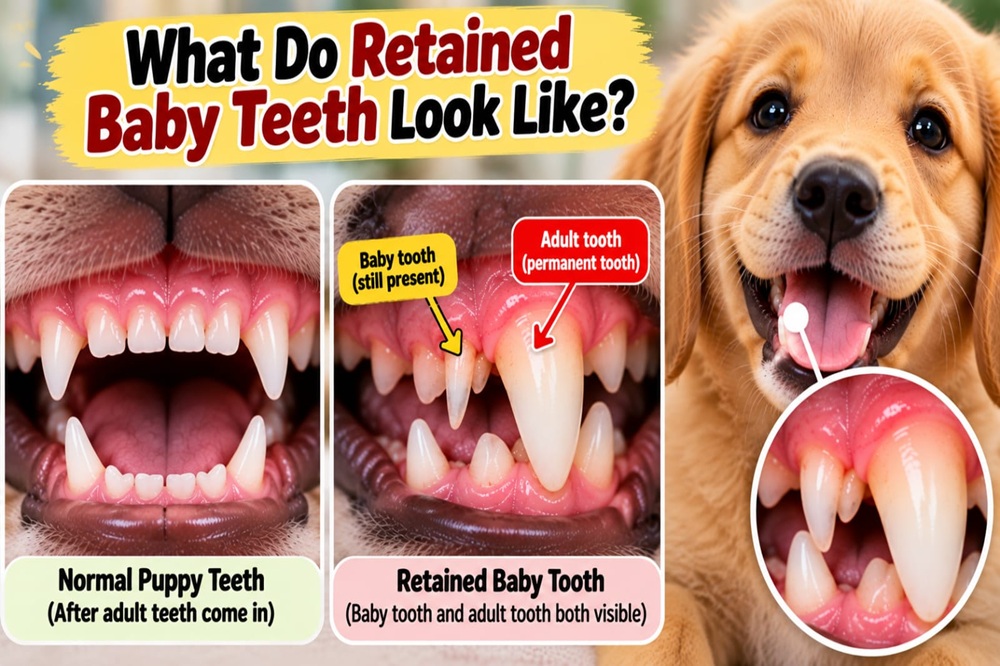
One of the easiest signs for an owner to recognize is the appearance of two teeth in the same location.
For example, you may see a large permanent canine tooth next to a smaller, sharper baby canine tooth.
The permanent tooth may also appear to be growing at an unusual angle because the retained baby tooth is occupying the space it needs.
The most commonly retained teeth in dogs are the canine teeth, although other baby teeth can also remain. Retained teeth are reported more often in small-breed and short-nosed dogs.
Why Do Some Puppies Retain Their Baby Teeth?
There is not always one obvious reason.
The normal shedding of a baby tooth depends on the development and eruption of its permanent replacement. If the permanent tooth does not erupt in the expected position, the baby tooth may remain firmly attached.
Genetic factors can also play a role. Retained deciduous teeth are particularly common in some small breeds, and veterinary sources note that there can be a familial or genetic predisposition.
In some situations, trauma during tooth development can also affect normal tooth positioning and eruption.
Common Signs of Retained Baby Teeth
A retained baby tooth may not cause obvious symptoms at first. In many cases, the owner simply notices an unusual tooth arrangement during a routine mouth check.
Possible signs include:
Two teeth appearing in the same area
A baby tooth remaining beside an adult tooth
Crowded teeth
A permanent tooth growing at an unusual angle
Food getting trapped between teeth
Red or irritated gums
Bad breath
Plaque or tartar buildup
Difficulty chewing
Abnormal contact between teeth
Some puppies may continue eating and playing normally even when a retained tooth is present, so the absence of obvious symptoms does not necessarily mean there is no dental problem.
Why Are Retained Baby Teeth a Problem?
The main concern is crowding and abnormal tooth positioning.
A puppy’s adult teeth are larger and need more space than the baby teeth. If a baby tooth remains in the mouth, it can force the permanent tooth into an abnormal position. This can lead to an incorrect bite, known as malocclusion.
Crowded teeth can also create small spaces where food and debris become trapped. This can encourage plaque accumulation and inflammation around the gums.
Over time, these conditions may contribute to gingivitis and periodontal disease.
A badly positioned tooth can also rub against another tooth, the gums, or other soft tissues. In some puppies, this can cause pain or injury.
Which Baby Teeth Are Most Commonly Retained?
Although any deciduous tooth can potentially remain, canine teeth are among the most commonly retained baby teeth.
The upper canine teeth are reported most frequently, followed by the lower canine teeth and incisors.
This is important because canine teeth are large and their position can have a significant effect on the puppy’s bite.
How Can You Check Your Puppy at Home?
You can gently look inside your puppy’s mouth during the teething period.
Do not force the mouth open. Instead, when your puppy is calm, gently lift the lips and look at the teeth.
Pay particular attention to:
Whether there are two teeth in one location
Baby teeth that remain while adult teeth are emerging
Crowded teeth
Teeth pointing in an unusual direction
Red or swollen gums
Food trapped around the teeth
Signs of pain or discomfort
VCA recommends regularly checking a puppy’s mouth during the teething period because dental problems can be easier to address when identified early.
When Should You Contact a Veterinarian?
If you notice a baby tooth still present next to an erupting permanent tooth, contact your veterinarian rather than waiting for the tooth to fall out on its own.
This is particularly important if the puppy has:
Two teeth occupying the same space
Significant tooth crowding
An abnormal bite
A tooth touching the roof of the mouth
Gum swelling or bleeding
Difficulty eating
Mouth pain
Persistent bad breath
Early veterinary assessment can help prevent the permanent tooth from becoming permanently displaced.
How Are Retained Baby Teeth Diagnosed?
A veterinarian will examine the puppy’s mouth and evaluate the position of the baby and permanent teeth.
In some cases, dental X-rays may be recommended, particularly when the permanent tooth cannot be seen or when the veterinarian needs to evaluate the roots and developing permanent tooth.
Radiographs can help determine whether an unerupted or impacted permanent tooth is present and whether there are other abnormalities beneath the gumline.
Treatment for Retained Baby Teeth
When a baby tooth remains after its permanent replacement has started to erupt, the veterinarian will often recommend extraction of the retained tooth.
The goal is to remove the obstruction and give the permanent tooth the best opportunity to move into a more appropriate position.
The timing matters because delaying treatment can allow abnormal tooth positioning or bite problems to become more established.
Extraction is normally performed by a veterinarian under appropriate anesthesia. Special care is required because the developing permanent tooth and its structures are located close to the retained baby tooth.
Can You Pull a Retained Baby Tooth at Home?

No.
Do not try to pull, twist, or forcibly remove a retained baby tooth yourself.
The roots of baby teeth can be delicate, and incorrect extraction can damage the developing permanent tooth. Veterinary extraction allows the tooth to be removed safely while protecting the permanent tooth underneath.
Can Retained Baby Teeth Be Prevented?
There is no guaranteed way to prevent every retained baby tooth, particularly when genetic or developmental factors are involved.
However, regular dental checks can help identify the problem early.
During your puppy’s teething period:
Check the mouth regularly.
Look for two teeth in the same position.
Watch for abnormal tooth angles.
Monitor gum redness or swelling.
Provide safe, puppy-appropriate chew toys.
Introduce gentle tooth brushing gradually.
Ask your veterinarian to check the teeth during routine puppy visits.
Early detection is especially valuable because developing dental problems may be easier to manage before they cause significant changes to the permanent teeth or bite.
Final Thoughts
Retained baby teeth are a relatively common dental development problem in puppies. They occur when a baby tooth remains in the mouth while its permanent replacement is already erupting.
The easiest sign for an owner to recognize is often two teeth occupying the same area.
Although a puppy may appear completely healthy, retained teeth can contribute to crowding, abnormal tooth positioning, food trapping, gum inflammation, and bite problems.
If you notice a retained baby tooth, don’t try to remove it yourself. Have your puppy’s mouth examined by a veterinarian so the tooth position can be evaluated and appropriate treatment can be recommended.
Regular mouth checks during puppyhood are a simple way to catch dental problems early and help your puppy develop a healthier permanent set of teeth.